
Abakada.org — Free digital tools for learning anywhere
Abakada.org brings free educational software and offline browser tools together for Filipino learners, teachers, students, and communities with limited connectivity.
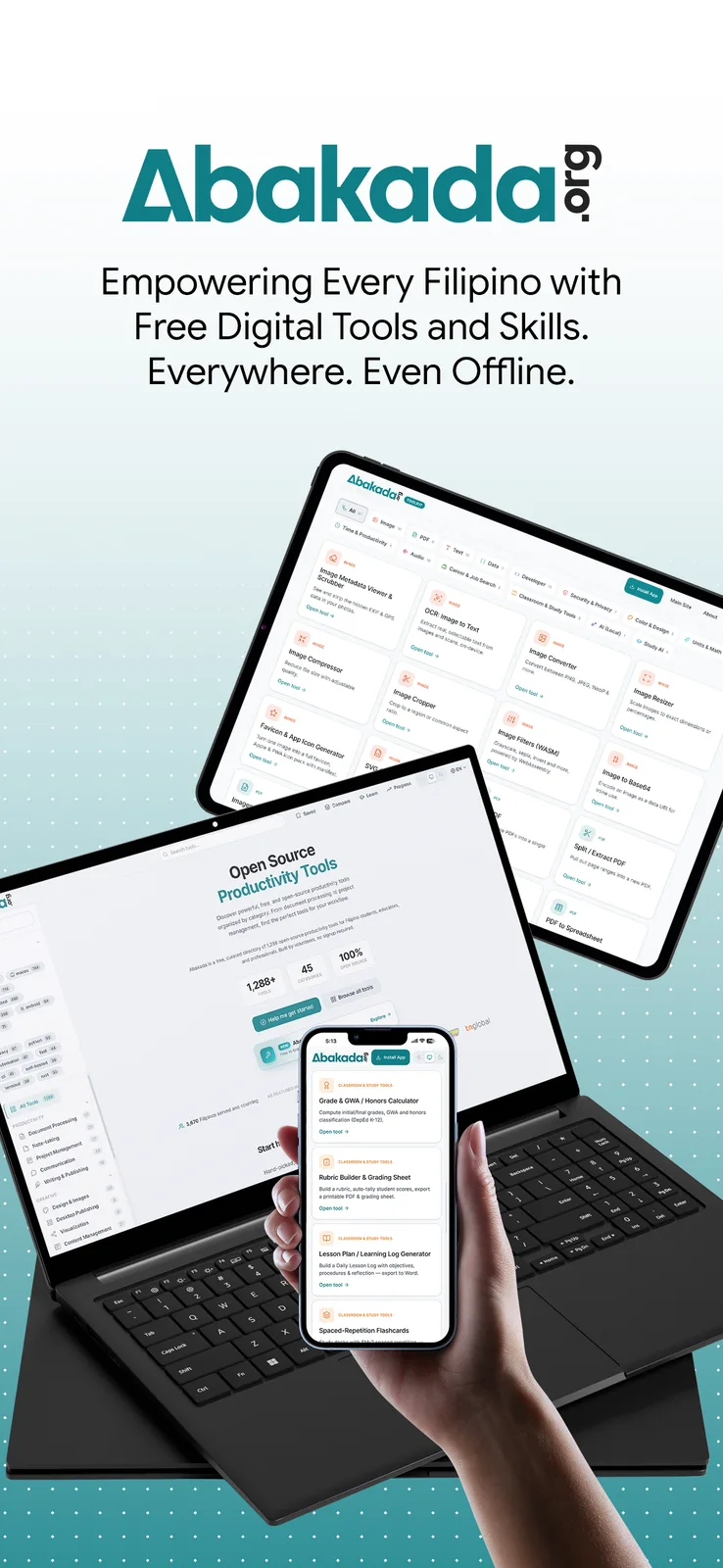
Abakada.org is built around an idea that feels both practical and deeply generous: access to useful digital tools should not depend on expensive software or a perfect internet connection. The platform brings together free and open-source programs, browser utilities, and digital skills resources with a clear focus on helping people learn and work wherever they are.
A toolkit shaped around access
The listing describes Abakada.org as a free digital platform for Filipino students, teachers, out-of-school youth, and professionals, especially people in rural communities facing poor connectivity or the cost of commercial software. That context gives the app a strong sense of purpose. It is not simply collecting tools for the sake of having a large directory. It is trying to make a useful starting point available to people who may otherwise be left out.
At the center is a hand-curated catalog of more than 1,288 verified free and open-source educational programs. That is a substantial amount of material to bring into one place, and the word “curated” matters. Finding software can be difficult when the choices are scattered across the web. A thoughtful catalog can make discovery easier for a learner, teacher, or professional who needs to find the right tool without sorting through endless uncertainty.
Useful even when the connection is not
The Abakada Toolkit adds more than 90 browser-based utilities, but the most distinctive part of the platform may be its offline-first design. As a Progressive Web App, it can install directly to a device and work offline. That makes the project feel grounded in the conditions its audience actually faces. The platform is designed around the possibility that internet access may be limited, interrupted, or too expensive to rely on constantly.
There is something especially appealing about that choice. Offline support is not presented as a special extra; it is part of the way the platform imagines access. A learner can keep working, a teacher can prepare materials, and a professional can use a utility without every task depending on a live connection. That kind of continuity can make digital tools feel more dependable.
Privacy as part of the mission
Abakada.org also takes a strong position on privacy. The listing says there are no user accounts, no backend databases, and no data tracking, with everything running locally on the user’s device. That approach gives the platform a clear and reassuring identity. People can explore educational programs and use browser tools without turning the experience into another account-management task.
For students and communities, that simplicity matters. The platform keeps the attention on learning and making, while its local-first structure gives users more control over their information. The technology supports the mission instead of getting in the way of it.
More than a directory
What makes Abakada.org memorable is the connection between its catalog and its wider advocacy. The project describes itself as a grassroots effort to help build a digitally empowered Philippines and make education more accessible. That gives the directory a human quality. Every program in the catalog and every toolkit utility contributes to a larger idea about reducing barriers and helping people take part in digital life.
I can see the platform being valuable to someone discovering free software for the first time, as well as to a teacher or community organizer looking for reliable resources to share. It has the breadth of a directory, but the purpose of a public service.
A digital lifeline with practical details
Abakada.org leaves an impressive impression because its values are reflected in the way it works: free resources, offline access, open-source tools, and privacy-first use. It offers a practical place to begin, while also pointing toward a larger belief that digital education should be available to more people. For Filipino learners and the communities around them, this is an unusually meaningful kind of platform to have within reach.
Abakada.org · image 1
Abakada.org · image 2